
A pair of amber tinted glasses sits on the desk, the phone has slipped into its warm night setting, and somewhere in the back of the mind is a tidy villain: blue light, the thing keeping you awake. It has become the default explanation for a restless evening and the default fix sold to solve it. Filter the blue, the thinking goes, and sleep should follow.
The instinct behind it is sound. Light and sleep really are wired together, and the light you meet in the hours before bed really can push your night around. The trouble is that the popular remedy takes a real relationship and pins it on the wrong variable. It treats the color of the light as the problem, when the more powerful levers are how bright that light is and when it reaches your eyes.
So it is worth taking the question apart. What does evening light actually do to sleep, why is blue light mostly the wrong thing to blame, and what does the evidence honestly support. The answer is calmer than the marketing, and more useful.
What evening light actually does
Light is the main signal your body uses to tell day from night. As the world outside dims in the evening, the body begins to raise melatonin, its internal signal of darkness and the cue that the night has begun. Light in the eyes at that hour interrupts the message. It blunts the rise of that night time signal and nudges the internal clock later, so the whole system drifts toward a later bedtime. Where morning light pulls the clock earlier, evening light does the reverse.
What decides the size of that effect is mostly intensity and timing, not color. The circadian system turns out to be strikingly sensitive to ordinary indoor light. In a 2019 study in PNAS, Phillips and colleagues exposed 55 healthy adults to a range of evening light levels and found that, on average, it took only about 25 lux to suppress melatonin by half, a level comparable to or lower than typical indoor lighting and the glow of everyday screens. Levels of 10, 30 and 50 lux delayed the body's melatonin onset by roughly 22, 77 and 109 minutes.
Evening light shifts sleep mainly through its intensity and its timing: the brighter the light, and the closer to bedtime it reaches the eye, the more it blunts the body's night time signal and pushes the internal clock later, largely regardless of the light's color.
Why blue takes the blame
The blue story is not invented out of nothing; it has a real root in biology. Alongside the rods and cones that let you see, the eye carries a separate set of sensors, a small population of cells that report on light purely to set the body's clock. They are most responsive to short wavelength light, in the blue part of the spectrum near 480 nanometers, and they feed almost directly into the brain's master clock.
Because of that tuning, blue light is genuinely more potent, photon for photon, at moving the system. In a 2003 study, Lockley and colleagues showed that light at 460 nanometers, a deep blue, produced about twice the melatonin suppression and twice the circadian delay of 555 nanometer green light delivered at the same intensity. So the headline is not a myth: the clock is blue shifted, more sensitive to blue than your daytime vision is. That single fact is what the entire blue light industry is built on.
Why the blue framing is mostly the wrong thing
The problem is what gets lost between that fact and the fix. Blue being potent per photon does not make it the thing worth chasing, for two reasons.
The first is dose. A screen is a dim light source next to the sky. According to the authors of a major 2023 review, the blue light your eyes receive from an artificial source like a computer screen is roughly a thousandth of what you get from natural daylight. A phone at night is a faint stimulus compared with a single step outdoors at noon, and it is the total amount of light reaching the eye, not only the slice that happens to be blue, that does most of the work.
The second is that blue is not acting alone. Melatonin can be suppressed by light across a broad band of the spectrum, roughly 420 to 600 nanometers, so green, amber and plain white light all carry some of the same signal. Removing only the bluest sliver leaves most of that signal intact. This is why block the blue and you are fixed is too simple a story: it isolates one ingredient of a stimulus whose real strength is its brightness and its hour.
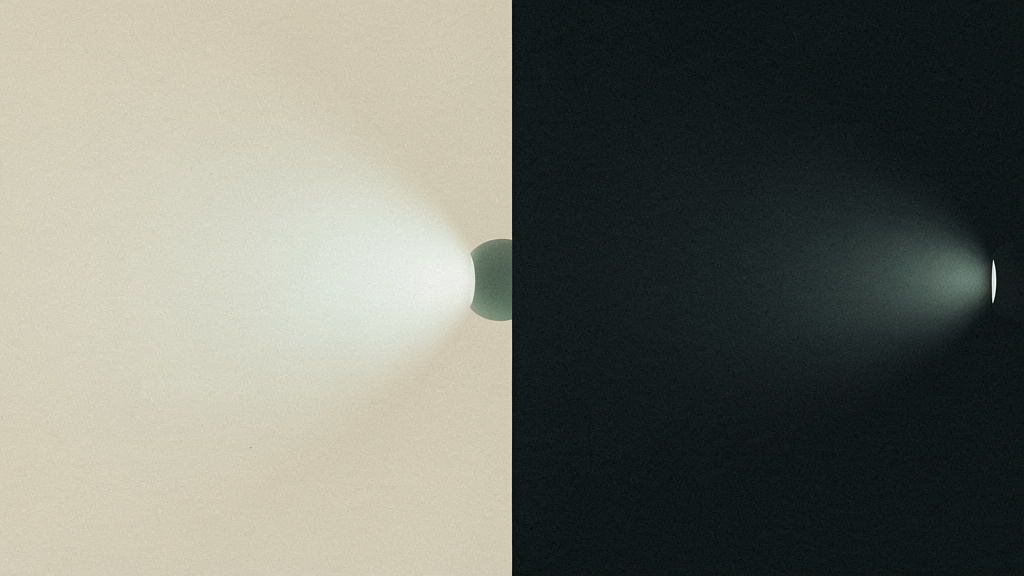
A bright source and a dim source cast the same colored light across a bone field, yet only the bright one carries a strong signal deep into the dark, an abstract image of intensity and timing outweighing color.
What the glasses can and cannot do
This is where blue light glasses meet the evidence, and the evidence is sober. A 2023 Cochrane review, the most rigorous look at the question so far, pooled 17 randomized controlled trials covering 619 people across six countries. It found that the lenses probably make little or no difference to the eye strain of screen work, and that their effects on sleep were inconclusive and uncertain, resting on low certainty evidence. The authors concluded plainly that the findings do not support recommending these lenses to the general population.
Part of the reason is mechanical. The same review's authors noted that typical blue light filtering lenses remove only about 10 to 25 percent of blue light; filtering much more would require an obvious amber tint that distorts color. A 2025 analysis in Translational Vision Science and Technology went further, proposing a standard measure of filtering strength and finding that many clear, lightly tinted lenses sold as blue blockers do not remove enough of the relevant light to matter, while stronger amber and orange filters, worn at the right time, can. The honest reading is not that filtering light is useless, but that most consumer glasses filter too little, and too indiscriminately, to do what the label implies.
A filter lifts away one thin band from a broad field of light while the rest of the signal passes straight through it, an abstract image of a lens that removes only a small slice of what reaches the eye.
The part that has nothing to do with color
There is also a piece of the screens at night problem that no lens can touch, because it is not about melatonin at all. Light is directly alerting. Through those same clock setting cells, light in the evening raises arousal and wakefulness on a separate pathway, quite apart from what it does to the night time signal. A bright, engaging room simply makes the brain more awake.
And then there is the obvious part: what you are doing on the screen. The content is built to hold attention, and the later a gripping episode or an unfinished argument runs, the longer it delays sleep, whatever the light's spectrum. Screens before bed are really three things at once, light, alerting and behavior, and a colored lens addresses only a thin corner of the first.
What the evidence honestly supports
Put together, the picture points away from the colored lens and toward something plainer. The lever with the strongest mechanistic support is not the tint of the light but its amount and its timing: less light in the evening, dimmer light, and less of it in the last hour or two before bed, done consistently. Lowering the brightness of a room speaks directly to the intensity that the research keeps identifying as the driver. A blue blocking filter can help at the margins if it is genuinely dark enough and worn at the right hour, but as a stand alone cure it aims at the smaller variable.
One more finding keeps the whole subject honest. In that 2019 study, sensitivity to evening light varied more than fiftyfold between individuals: the same dim room that barely touched one person cut another person's night time signal in half. There is no universal number of lux, which is exactly why a general habit beats a gadget. This is close to how we read the day at omnyx, as a pattern of inputs held over weeks and understood alongside a physician who knows the rest of your health, not a single product bought to rescue one night. If restless nights have hardened into something more, that is worth raising with a physician or a qualified sleep professional. The popular fix feels like solving the problem. Dimming the evening, earlier and more consistently, is closer to actually doing it.
Common questions
Does blue light really affect sleep?
Light in the evening does affect sleep, but blue light is only part of it. Light reaching the eye before bed suppresses melatonin, the body's internal signal of night, and nudges the internal clock later, which can delay sleep. The size of that effect is driven mostly by how bright the light is and how close to bedtime it arrives, not by its color. Blue wavelengths are somewhat more potent for this, but ordinary room light and screens of any color carry the same basic signal.
Do blue light glasses work?
The best current evidence is unconvincing. A 2023 Cochrane review of 17 randomized controlled trials found that blue light filtering glasses probably make little or no difference to screen related eye strain, and that their effects on sleep were inconclusive and of low certainty; the authors said the findings do not support recommending them to the general population. Part of the reason is that typical lenses filter only about 10 to 25 percent of blue light. Stronger amber or orange filters worn at the right time may help some people, but most clear lenses sold as blue blockers remove too little light to matter.
Why do screens make it harder to fall asleep?
For three reasons that stack together. The light itself suppresses the body's night time signal and can shift the internal clock later; light is also directly alerting, raising wakefulness on a pathway separate from melatonin; and the content is engaging, so the later it runs the longer it delays sleep. A colored lens addresses only a small part of the first of these. Lowering the brightness and setting the device down earlier addresses all three.
Is it the blue light or the brightness that matters more?
Brightness and timing matter more for most people. Blue wavelengths are more potent per unit of light, and a 2003 study found deep blue light suppressed melatonin about twice as much as green light of equal intensity. But screens are dim compared with daylight, roughly a thousandth of daylight's blue by one estimate, and melatonin is suppressed by a broad range of wavelengths, not only blue. So dimming the overall light in the evening does more than filtering one narrow slice of it.
What actually helps reduce light's effect on sleep at night?
The approach with the strongest support is to lower evening light intensity and shift bright light away from the hours before bed, done consistently: dim the room, turn down overhead and screen brightness, and keep the last stretch before sleep dark. Individual sensitivity to evening light varies enormously, more than fiftyfold in one study, so there is no single correct light level. If sleep problems persist despite this, they are worth discussing with a physician or a qualified sleep professional.