

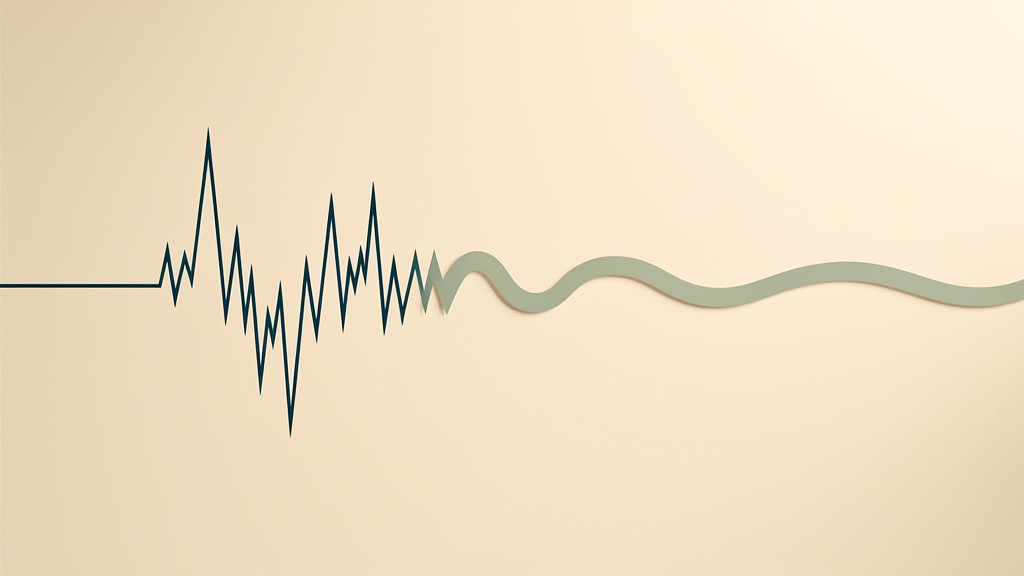
Growth hormone does not travel through the blood at a steady pace. It arrives in bursts, mostly overnight, with its largest and most predictable surge beginning roughly an hour to ninety minutes after deep sleep starts, plus a smaller one after hard exercise. Draw blood at the wrong moment and the same person can look flush with growth hormone or nearly empty of it, hours apart. That single fact makes growth hormone one of the hardest hormones to read from a random blood draw, and it is why almost nobody tests for it directly. Instead, the body offers a workaround: a second hormone that growth hormone triggers, one that does not spike and vanish the same way. That hormone is IGF-1.
The stand-in that stays still
IGF-1, short for insulin-like growth factor 1, is made mainly by the liver in direct response to growth hormone reaching it. That release does not follow the same jagged, pulsatile pattern as its trigger. As MedlinePlus explains, growth hormone levels change throughout the day depending on diet and activity, but IGF-1 levels are comparatively stable, which is why measuring IGF-1 has become the more reliable way to estimate average growth hormone activity over time.
The name is a bit of a misnomer. IGF-1 is not insulin, and it is not made by the pancreas. The "insulin-like" label refers only to a structural resemblance between the two molecules. IGF-1 does, however, share some of insulin's territory: it plays a role in how the body handles glucose and fat, part of why growth hormone disorders can eventually show up as blood sugar problems.
Growth hormone and IGF-1 work as a pair. Their most obvious job, promoting the growth of bone and tissue in children, ends once a person's growth plates fuse in late adolescence. But the job does not stop there. As Cleveland Clinic notes in its overview of growth hormone deficiency, after a person has finished growing, growth hormone still helps maintain normal body structure and metabolism, including keeping blood glucose within a healthy range. IGF-1 carries out much of that maintenance work directly in muscle, bone, and cartilage.
A number that moves with age, not just health
Because IGF-1 tracks growth hormone, and growth hormone output itself changes across a lifetime, IGF-1 reference ranges shift dramatically by age. According to MedlinePlus, IGF-1 levels are normally low in childhood, climb to their highest point during puberty, and then decrease through adulthood. The scale of that decline is not subtle. Testing.com publishes representative reference bands drawn from a major national reference lab: a healthy 20 to 24-year-old man might fall anywhere from 83 to 456 ng/mL, while a healthy man in his 70s might fall between 34 and 245 ng/mL, a range that has shifted downward by roughly half. A result that would be alarmingly low in a 25-year-old can be entirely unremarkable in someone twice that age, which is why every lab report pairs the number with an age- and sex-specific range rather than a single universal cutoff.
Reading the two directions
When IGF-1 comes back outside that expected range, the two directions point toward very different stories.
A high result usually means the body is making more growth hormone than it needs. Cleveland Clinic describes acromegaly, the adult condition caused by growth hormone excess, as a rare disorder affecting roughly 3 to 14 people in every 100,000, almost always caused by a benign pituitary tumor releasing growth hormone it should not. IGF-1 climbs along with that excess, and Cleveland Clinic notes it affects how the body processes sugar and fat, contributing to complications such as type 2 diabetes, high blood pressure, and heart disease over time. The condition develops slowly enough that people often notice it indirectly, through a ring that no longer fits or a shoe size that has quietly changed.
A low result is more often the less dramatic story, though the two age groups read differently. In children, MedlinePlus notes that lower than normal IGF-1 probably points to a genuine growth hormone deficiency or insensitivity, worth pursuing since early treatment gives a child the best chance at a normal adult height. In adults, the picture is murkier. Adult-onset growth hormone deficiency is rare, Cleveland Clinic estimates roughly 1 in every 10,000 adults, and MedlinePlus is direct about the practical implication: IGF-1 testing isn't common for adults, since other conditions are far more likely to explain fatigue, lower muscle mass, or reduced bone density than a growth hormone problem. A low adult result is more often tied to something else already in the differential: normal aging, chronic malnutrition, hypothyroidism, kidney disease, or liver disease can all suppress IGF-1 independent of what the pituitary gland is doing.
Why one result rarely settles it
Even a genuinely abnormal IGF-1 rarely closes the case by itself. Testing.com describes IGF-1 as typically the first-line screen, with a growth hormone stimulation or suppression test as the confirmatory step when the screen raises a real question. For children, that usually means a stimulation test: medication provokes a growth hormone release, and blood is drawn afterward to see whether the pituitary responded as expected. For adults, Cleveland Clinic describes the insulin tolerance test as a common diagnostic tool, deliberately lowering blood sugar with a small dose of insulin, since a healthy pituitary should answer that stress by releasing growth hormone; a blunted response points toward deficiency. IGF-1 is also rarely read in isolation. Because a struggling pituitary gland tends to affect more than one hormone at once, a provider evaluating IGF-1 will often check it alongside prolactin, FSH, and LH, the same signals covered in earlier notes on the hormones the pituitary sends out.
Before the blood draw
Practically, an IGF-1 test asks little of the person giving blood. MedlinePlus and Testing.com both note that no fasting or special preparation is required; a skipped meal will not move the number, though chronic, sustained undernutrition will suppress it over time regardless of growth hormone status. The one caveat worth knowing concerns biotin, the popular hair and nail supplement. Some IGF-1 assays use an antibody-based method that biotin can interfere with, a problem regulators have flagged for hormone immunoassays generally, so anyone on a high-dose biotin supplement is usually advised to pause it for roughly 72 hours before the draw. Tests run by mass spectrometry instead sidestep that particular interference, which is one reason it is worth telling whoever orders the test what supplements are actually being taken.
Common questions
What is a normal IGF-1 level? There is no single number that applies to everyone. Reference ranges are built around age and sex, rising through childhood, peaking during puberty, and declining steadily through adulthood, so a result that would be low for a 20-year-old can be ordinary for someone in their 60s. The only meaningful comparison is against the range printed for your own age and sex on the lab report.
Is IGF-1 the same thing as growth hormone? No. Growth hormone is released directly by the pituitary gland in short, unpredictable pulses. IGF-1 is made afterward, mainly by the liver, in response to that growth hormone, and it stays far more stable across the day, which is why it is usually the number checked first.
Does a low IGF-1 always mean a growth hormone problem? Not in adults. Adult-onset growth hormone deficiency is uncommon, and a low result is more often explained by something already on the table, such as normal age-related decline, undernutrition, an underactive thyroid, or liver or kidney disease. In children, a low result is taken more seriously, since growth hormone plays a more central role in development.
Do I need to fast before an IGF-1 test? No. Eating and drinking normally beforehand will not change the result. The one preparation step worth taking seriously is telling your provider about any high-dose biotin supplement, since it can interfere with certain lab methods and may need to be paused for a few days before the draw.
Can an IGF-1 test diagnose acromegaly or growth hormone deficiency on its own? Not by itself. An abnormal result is a strong reason to look further, but the confirming step is usually a stimulation or suppression test that measures how growth hormone behaves in response to a controlled trigger, sometimes alongside pituitary imaging.
IGF-1's real value is not the number itself but what it stands in for: a steadier echo of a hormone too erratic to catch in the moment. Reading it well means resisting the urge to treat one draw as a verdict, and asking what else is happening around it, at what age, and against what range.