
A Ranking, Not a Risk Score
Somewhere in the last several years, a single line escaped its source and started traveling on its own: hearing loss is the largest modifiable risk factor for dementia. It shows up in wellness columns and casual conversation, almost always doing the same quiet trick, borrowing the authority of a serious research commission and delivering it as though it were a personal warning. It is not. The claim behind the headline is a population attributable fraction, a modeled estimate of what share of dementia cases across a population might not occur if one exposure were fully removed, calculated under an explicit assumption that the exposure causes the outcome. That is a statement about a population, built on an assumption, not a measurement of what is happening inside any single body.
A population attributable fraction is a modeled estimate of what share of dementia cases across a whole population might not occur if one exposure were removed, under an assumption that the exposure is causal. It says nothing about any one person's odds.
Where the Number Came From, and Why It Moved
The estimate traces to a standing research commission that has published three major reports on dementia prevention, each revising its own model. The first, built around nine candidate factors, put their combined weighted share of dementia cases worldwide at roughly thirty-five percent, hearing loss carrying the single largest individual share, about nine percent. A second report added three factors, including alcohol and air pollution, widened the combined estimate to roughly forty percent, and hearing loss's own share slid to about eight percent. A third added two more, including vision loss, pushed the combined estimate toward forty-five percent, and hearing loss settled near seven percent. Hearing itself did not change across those years. The model did. Every factor's share is calculated so overlapping risk is not counted twice, so adding factors redistributes the accounting even when nothing about hearing has moved. Hearing loss has stayed near the top through every revision, genuinely notable. Worth sitting with the other side of that arithmetic too: even the most generous estimate leaves the majority of dementia risk, more than half, with age, genetics, and everything else the model does not capture.
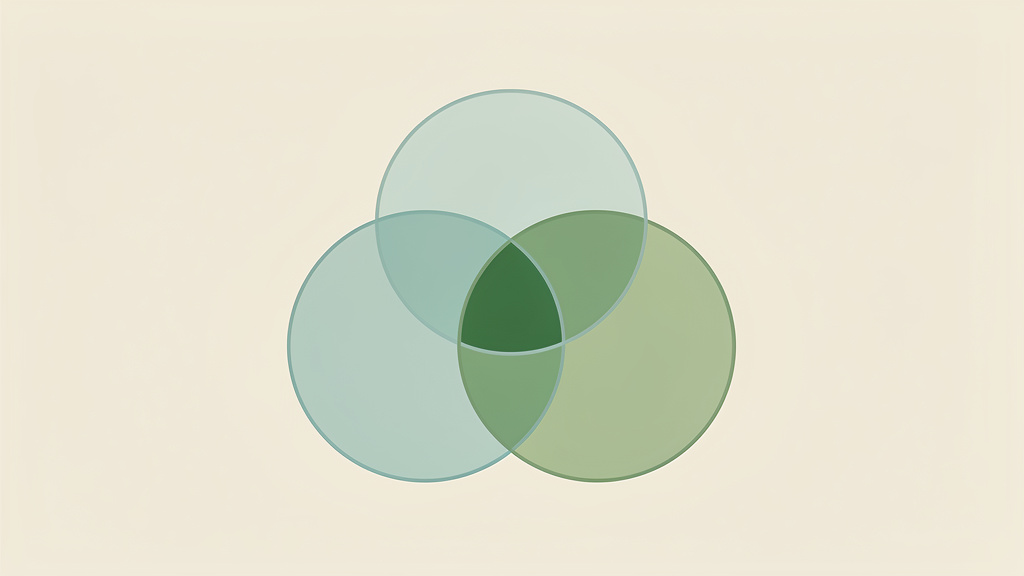
Three overlapping teal circles on a warm bone field, their shared regions shaded in matcha, an abstract image of estimates that overlap rather than simply add together.
Two Guesses About Why
If the association is real, and the observational evidence is fairly consistent, researchers have mainly proposed two routes, and neither is settled. The first is about effort. Speech degraded by hearing loss is not simply quieter, it is more cognitively demanding: the brain recruits additional resources to decode a weaker signal, resources otherwise free for memory and attention. Sustained over years, that reallocation is one plausible route from ear to cognition. The second is about withdrawal. Conversation in a noisy restaurant or a crowded gathering becomes exhausting, and people often quietly stop going. Reviews of the evidence link hearing difficulty to higher rates of loneliness and social isolation, both separately associated with cognitive decline. Neither route has been proven to be the mechanism, and they are not mutually exclusive; a person could be living out both at once.
What One Careful Study Found Instead
A prospective study within the Mayo Clinic Study of Aging offers a useful complication. Researchers followed twelve hundred older adults who had each undergone formal, audiologist administered hearing testing, tracking who went on to develop dementia over an average of seven years. After adjusting for age, education, and other factors, the objective hearing test scores were not significantly associated with a later dementia diagnosis. The same scores were significantly associated with faster decline on other cognitive tests over time, so the measurements were not meaningless, they simply did not predict a dementia diagnosis in this cohort. A separate measure, a study partner's report of the person's everyday hearing difficulty, was significantly associated with a later dementia diagnosis. About half of the people with measurable hearing loss on the formal test had no reported everyday difficulty at all. Something beyond the ear itself, plausibly related to how the brain processes sound rather than how well the ear detects it, may be doing real work in that gap.
A precise teal grid beside a looser sage outline of similar size, only partially aligned, an abstract image of two different ways of measuring the same thing.
Then a Trial Tested It
Observation can show an association; only a trial can test whether treating one thing changes another. The most direct attempt so far, a multi-year randomized trial, assigned older adults with untreated hearing loss to either a structured hearing intervention or a health education control, then measured cognitive change after three years. In the full trial population, cognitive decline did not differ significantly between the two groups, and that headline result deserves to be stated plainly rather than buried. A separate, pre-specified analysis then compared two distinct groups within the trial: people already enrolled in a long-running heart health study, who carried more cardiovascular risk and scored lower at the outset, and healthy volunteers recruited fresh from the community. The difference between those two groups was statistically significant, and within the higher-risk group alone, decline was meaningfully slower with the hearing intervention. That is a subgroup finding inside one trial, not a demonstrated general-population effect, and the two should not be described the same way.
What This Changes, and What It Does Not
None of this makes the ranking meaningless. A factor that lands near the top of a model built three separate times, by three different research teams, is not a fluke. What it changes is what a person should reasonably take from it. The ranking describes a population, not a prediction; the mechanisms remain plausible rather than proven; and the strongest trial evidence points toward a benefit concentrated in people already carrying other risk, not a universal effect. The omnyx read is that hearing belongs on a long list of ordinary, unglamorous inputs worth attention over a whole life, not because any one is a verdict, but because the list, together, is the whole game. Noticing a change in how conversation sounds is worth raising with an audiologist or a physician, mainly because comfort and communication matter now, on their own terms.
Common questions
Is hearing loss linked to dementia?
Multiple long-running observational studies have found an association between hearing loss and a higher rate of incident dementia, and three major research commission reports have ranked it among the largest modifiable contributors in their models. Association is not proof of cause, and one careful cohort study found that objective hearing test scores alone were not significantly linked to a later dementia diagnosis, even though a study partner's report of everyday hearing difficulty was.
What is a population attributable fraction?
A population attributable fraction is a modeled estimate of the share of cases of an outcome, here dementia, across an entire population that might not occur if one particular exposure were fully removed. The calculation assumes the exposure is causal and combines that assumption with the exposure's estimated prevalence and relative risk. It describes a population under a model, not any individual's personal odds.
Why is hearing called the largest modifiable risk factor for dementia?
Across three successive reports from the same research commission, hearing loss has carried the single largest individual weighted share among the factors included in each model, even as that share moved from roughly nine percent to about seven percent as more factors were added. Being largest among a specific, changing list of modifiable factors is different from being the largest contributor to dementia overall; age and genetics still account for the majority of total risk in every version of the model.
Does treating hearing loss prevent dementia?
The evidence does not currently support that claim. The largest randomized trial to test a hearing intervention against cognitive decline found no significant difference across its full study population after three years. A pre-specified analysis did find a significantly slower decline within one higher cardiovascular-risk subgroup of that trial, a real and encouraging result, but a subgroup finding inside one trial is not the same as a proven, general prevention effect.
At what age does hearing start to change?
Hearing sensitivity, particularly for higher frequencies, typically begins a gradual decline in midlife, often starting in a person's forties or fifties, well before it becomes noticeable in daily conversation. This is why the research commission models place hearing loss as a midlife factor rather than a late-life one, alongside conditions such as blood pressure, easiest to address well before symptoms become obvious.